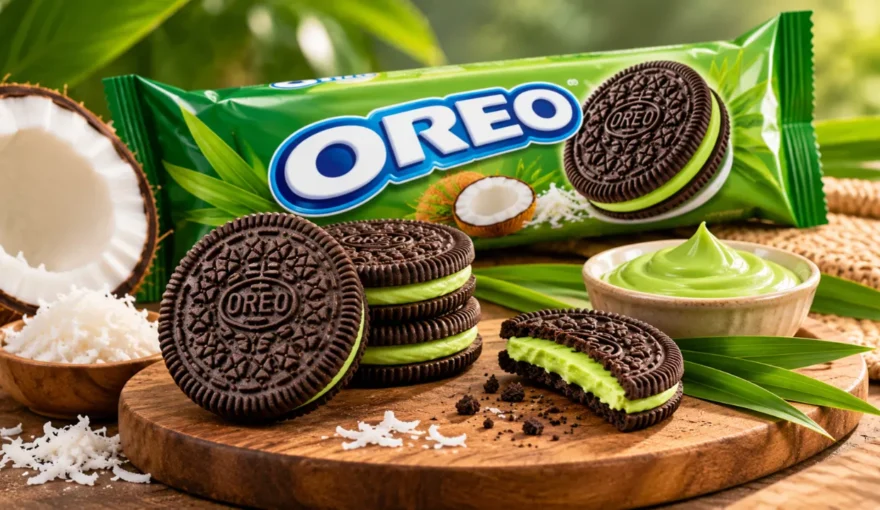
Pandan steps into the flavour spotlight with new Oreo Kelapa Pandan
For a long time, pandan has been the quiet ingredient in Southeast Asian kitchens. It’s the green leaf behind kueh in Jakarta, the scent of a good pot of rice and the colour of a thousand street desserts. Now it’s on one of the best-known biscuits in the world. Oreo has launched Oreo Kelapa Pandan in Indonesia, putting pandan and coconut in its classic chocolate sandwich cookie.
It looks like a small seasonal addition to the shelf, but it says a lot about where flavour trends in the region are going.
What’s Inside the New Oreo Kelapa Pandan

The idea is simple. You get Oreo’s familiar dark chocolate biscuit with a filling flavoured with fragrant pandan and a soft, mellow coconut richness. “Kelapa” means coconut in Bahasa Indonesia, so the name says exactly what’s in it.
Anyone who grew up eating Indonesian sweets will know the pairing at once. Pandan and coconut go together in local desserts the way vanilla and cream do in Western baking. They turn up together in klepon, dadar gulung, serabi and kue lapis. Putting that pairing next to cocoa gives the cookie a flavour that feels both nostalgic and new.
Product Snapshot
| Detail | Information |
|---|---|
| Product name | Oreo Kelapa Pandan |
| Brand | Oreo |
| Market | Indonesia |
| Biscuit | Classic Oreo chocolate biscuit |
| Flavour profile | Fragrant pandan with mild coconut richness |
| Meaning of “Kelapa” | Coconut (Bahasa Indonesia) |
| Price / pack size | Not disclosed at launch |
| Reported | 20 November 2026 |
Why Pandan, and Why Now?
Pandan isn’t a new flavour, and that’s exactly why it works. It’s a heritage flavour with strong emotional ties for millions of people across Indonesia, Malaysia, Singapore and Thailand. When a global brand uses it, the product feels local without being a gimmick.
It also helps that pandan stands out. It has a sweet, grassy, almost vanilla-like smell that’s hard to mistake for anything else. Its soft green colour is also an easy cue on packaging. On a crowded biscuit aisle, a green-accented Oreo pack gets noticed quickly.
Industry watchers point out that this is the bigger opportunity. Brands can use pandan’s aroma, its familiar green colour and its Southeast Asian roots to set a product apart in both taste and look. Pandan is no longer just a traditional dessert flavour. It’s becoming a flavour for modern, mass-market snacks.

Oreo’s Long Habit of Local Flavours
This isn’t the first time Oreo has tailored its cookie for Asian markets. The brand has a track record of regional flavours, and Indonesia has often been a testing ground.
| Oreo Variant | Markets | Notes |
|---|---|---|
| Strawberry Creme | Indonesia, Malaysia, Philippines, South Korea, Singapore, Chile | Launched 2001 |
| Chocolate Creme | US, Indonesia, Malaysia, Philippines, China and others | Launched 2001 |
| Coconut Delight | Indonesia | Coconut creme filling |
| Blueberry Ice Cream | Singapore, Indonesia, Malaysia | Launched 2010 |
| Green Tea | China, Japan | Regional favourite |
| Kelapa Pandan | Indonesia | Pandan + coconut, 2026 |

Coconut Delight is a useful comparison. Oreo has already put a coconut filling on Indonesian shelves, so adding pandan looks like a logical next step built on a flavour shoppers already like.
Could Pandan Travel Beyond Southeast Asia?
China is the market getting the most attention. Pandan is already showing up there in bakery products, bubble tea and café menus, so shoppers are becoming familiar with it. If Kelapa Pandan does well in Indonesia, the format could be adapted for other markets where pandan is just starting to appear.
That would follow a familiar path. Matcha went from a speciality Japanese ingredient to a global café staple, and ube went from a Filipino favourite to an Instagram regular. Pandan has the same mix of a distinctive taste, a recognisable colour and a story behind it.
The Takeaway for Food Brands
Oreo Kelapa Pandan shows a wider trend: people want comfort with a local twist. Big snack brands are finding that heritage flavours are commercially valuable and help build connection and loyalty. A biscuit that tastes like a grandmother’s kitchen can sometimes outsell one chasing the latest novelty.
For Indonesian snackers, it’s a nod to a flavour they already love. For everyone else, it might be their first taste of pandan, and it probably won’t be their last.