The Price of a Big Mac Around the World
Most people order a Big Mac without thinking about exchange rates. Economists see it differently. The Economist has tracked the burger’s price across dozens of countries for 40 years, and it has become one of the easiest ways to see how far a dollar actually goes once you cross a border.
The idea is simple. A Big Mac is close to the same product wherever you buy it: two patties, the special sauce, lettuce, cheese, pickles, onions and a sesame bun. If currencies were priced “correctly,” the burger should cost about the same everywhere once you convert the price into U.S. dollars. It doesn’t, and the size of the gap is what makes the comparison interesting.
The 2026 Numbers at a Glance

In the January 2026 edition of the index, a Big Mac cost $6.12 in the United States. That figure is the baseline. Every other country is measured against it.
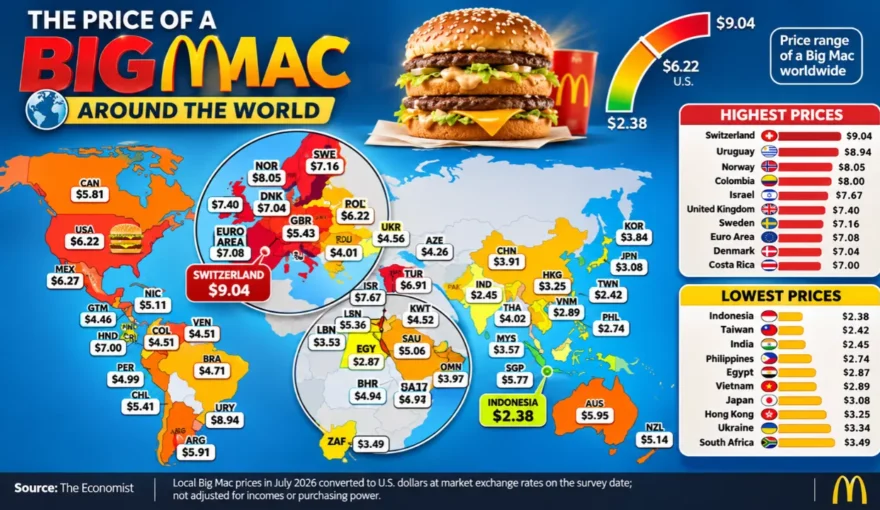
At the top of the list is Switzerland, where the burger cost $9.08, about 48% more than in America. At the bottom is Taiwan at $2.47, nearly 60% cheaper. Put another way, a Swiss customer pays for one Big Mac what a customer in Taipei pays for almost four.
Here’s how selected economies compare:
| Rank | Country / Area | Big Mac Price (USD) | vs. U.S. Price |
|---|---|---|---|
| 1 | Switzerland | $9.08 | +48.4% |
| 2 | Uruguay | $8.76 | +43.1% |
| 3 | Norway | $7.52 | +22.8% |
| 4 | Sweden | $7.26 | +18.6% |
| 5 | Denmark | $7.14 | +16.7% |
| 6 | Britain | $7.08 | +15.7% |
| 7 | Euro area | $7.05 | +15.3% |
| 8 | Israel | $6.36 | +4.0% |
| 11 | Mexico | $6.17 | +0.8% |
| 12 | United States | $6.12 | Baseline |
| 15 | Singapore | $5.78 | −5.5% |
| 16 | Australia | $5.69 | −7.0% |
| 17 | Canada | $5.54 | −9.4% |
| 22 | UAE | $5.17 | −15.5% |
| 32 | Brazil | $4.45 | −27.3% |
| 41 | South Korea | $3.74 | −38.9% |
| 42 | China | $3.66 | −40.2% |
| 45 | South Africa | $3.36 | −45.1% |
| 48 | Japan | $3.03 | −50.5% |
| 51 | Egypt | $2.65 | −56.8% |
| 52 | Indonesia | $2.52 | −58.9% |
| 53 | India | $2.51 | −58.9% |
| 54 | Taiwan | $2.47 | −59.6% |
Source: The Economist Big Mac Index, January 2026 (54 economies), via Mappr.
Why Europe Sits at the Top
Look at the top seven and one thing stands out: apart from Uruguay, they’re all European. Switzerland, Norway, Sweden, Denmark and Britain have high wages, expensive commercial rent and strong currencies. All of that ends up in the price of a fast-food meal. A restaurant worker in Zurich earns far more than one in Jakarta, and McDonald’s prices reflect that.
Uruguay is the outlier. Its Big Mac has climbed sharply over the past two decades, and it is now the only non-European country near the very top. Israel also sits above the U.S. line, which is a reminder of how expensive daily life there has become.

Why Asia Fills the Bottom

The cheapest burgers are mostly in Asia. Taiwan, India, Indonesia, the Philippines, Vietnam and Japan all sit near the bottom, with Egypt and South Africa close behind.
Japan is the one that surprises people. It’s a wealthy country, yet its Big Mac costs about half of the American price. The reason is mostly the yen, which has lost a large share of its value over the past decade. One commentator pointed out that a Big Mac in Japan now costs about 20% less than one in China, which would have seemed unlikely ten years ago.
India deserves a note too. McDonald’s there doesn’t sell a beef Big Mac. The index uses the local chicken equivalent, the Maharaja Mac, so the comparison isn’t perfectly like-for-like.
What the Index Really Tells You
The Economist calls this a lighthearted guide, and that’s fair. A cheap Big Mac doesn’t automatically mean a currency is badly mispriced. The burger’s price includes costs that never cross a border, like rent, electricity and local wages. Those tend to be lower in poorer countries, so their currencies almost always look “undervalued” on the raw index.
To deal with that, The Economist also publishes a GDP-adjusted version that compares each country’s price with what you’d expect given its income level. Taxes, tariffs, local competition and how McDonald’s positions itself in each market all affect the final price as well.
Even so, the index is still useful. Travelers can get a rough sense of how expensive a country will feel, and anyone can see currency swings in a way that’s far easier to follow than a forex chart.
In 2026, the same burger costs anywhere from about $2.50 to over $9, depending on where you’re standing. Europe’s wealthy, high-wage economies pay the most, while much of Asia pays the least. It’s a fun statistic, but it also shows that money is worth a very different amount from one place to the next.