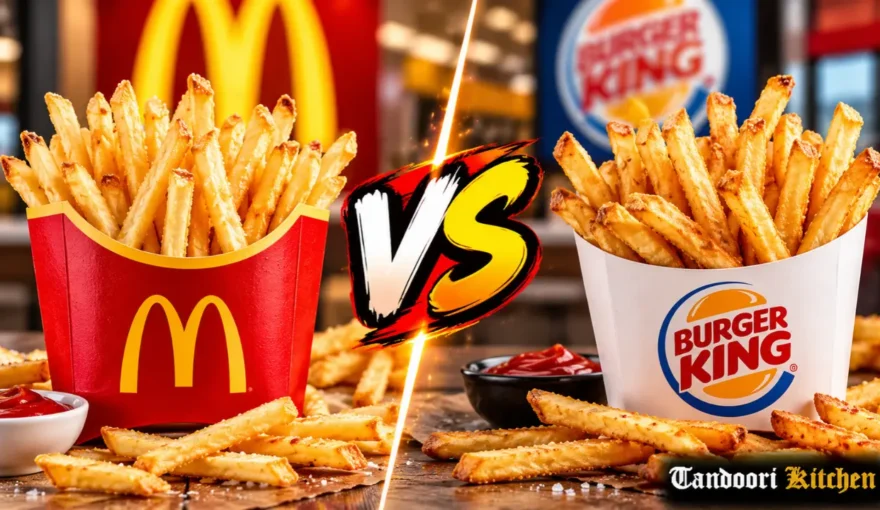
McDonald’s Fries vs. Burger King Fries: Which Fast-Food Fries Win?
McDonald’s fries are the benchmark. They are thin, salty, golden, and best in the first five minutes out of the bag. Burger King’s fries are thicker and sturdier, and fans say they hold their crunch longer. Each chain has loyal supporters, and the argument usually ends the same way: it depends on what you want from a fry.
The two aren’t the same on the label, either. McDonald’s fries have a long ingredient list, including a flavoring that means they aren’t vegetarian in the US. Burger King’s list is reported to be shorter, although some sources disagree about its details, so it is worth checking each chain’s own allergen guide. Calorie numbers also vary a lot from site to site, which is why this article avoids treating any single figure as exact.
The table below compares them side by side, and the sections after it cover taste, texture, ingredients, nutrition, and how to get the best fries from either drive-thru.
McDonald’s vs. Burger King Fries at a Glance
| Factor | McDonald’s fries | Burger King fries |
|---|---|---|
| Cut and look | Thin, shoestring-style | Thicker, wider cut |
| Texture | Crisp edges, fluffy inside; best fresh | Sturdier, tends to stay crisp longer |
| Flavor | Salty, savory, with a distinct “fry” flavor | Well seasoned, more potato-forward, per some tasters |
| Ingredient list | Longer, with oils, natural beef flavor, dextrose, and more | Reported as shorter, but check the chain’s current allergen guide |
| Vegetarian/vegan (US) | No, contains natural beef flavor from wheat and milk derivatives | Check the current allergen guide, since sources conflict |
| Contains wheat and milk (US) | Yes, per the chain’s listing | Check the allergen guide |
| Calories (medium) | Published figures vary by source and market | Published figures vary by source and market |
| Best eaten | Right away | Fresh, but holds up better as it cools |
Nutrition and ingredients change over time and differ by country, so check each chain’s official nutrition calculator and allergen guide for current numbers.
Taste and Texture
McDonald’s fries are thin, so they crisp quickly and have a high ratio of crunchy outside to soft inside. The salt clings well, and the flavor is savory and instantly recognizable. The drawback is timing. Thin fries lose heat and crispness quickly, so they are at their best within a few minutes of leaving the fryer.
Burger King fries are thicker, which gives them a fluffier middle and a sturdier bite. In one 2026 taste test, a reviewer found Burger King’s fries better seasoned, more consistently crispy, and more flavorful as they cooled, and preferred them to McDonald’s. The same reviewer noted that a colleague’s earlier ranking had placed McDonald’s several spots above Burger King, so the result is as much about personal taste as anything else.
If you want that classic thin, salty, fresh-from-the-fryer experience, McDonald’s is hard to beat when the batch is hot. If you eat in the car or at a desk, thicker fries may travel better.
What’s in Them?
McDonald’s. The ingredient list in the US is longer than most people expect. It includes potatoes, a blend of vegetable oils (canola, soybean, and hydrogenated soybean oil), natural beef flavor made from wheat and milk derivatives, dextrose (a sugar), sodium acid pyrophosphate to keep the color, and salt. The fries are cooked in vegetable oil with additives such as citric acid and an anti-foaming agent. The beef flavor was added to mimic the taste from the days when the chain fried in beef fat, before it switched to vegetable oil in the early 1990s. As a result, McDonald’s US fries are not vegetarian or vegan and are not suitable for people with wheat or milk allergies. In Canada and the UK, the fries are reported to be vegan-friendly, so the recipe differs by country.
McDonald’s says its fries have 0 g of trans fat per serving, which is allowed on a label when the amount is under 0.5 g, even though the recipe includes hydrogenated soybean oil. The potatoes come from russet varieties such as Russet Burbank, Umatilla, Shepody, and Ranger.
Burger King. One report notes that Burger King’s fries contain fewer ingredients than McDonald’s, with only one type of oil and no natural beef flavor or dextrose. Other sources disagree about the beef flavor, and Burger King’s recipe and coating can differ by market and change over time. If you have a dairy, wheat, or vegetarian restriction, check the chain’s current allergen information, because this is one of the areas where sources contradict each other.

Calories and Nutrition
Calorie figures for both chains are inconsistent across the web. One comparison lists a medium McDonald’s order at about 410 calories and a medium Burger King order at about 440, while another page lists a Burger King medium at about 340 calories. Portion sizes, recipes, and years vary, and many of the pages that publish these numbers are low-quality copies.
The reliable takeaway is that a medium order at either chain is a high-calorie side, roughly a third of a meal’s worth of calories for many people, with a lot of fat and sodium. A large order is far more, and the extras add up quickly, including dipping sauces, which typically add 50 or more calories per packet. For exact current numbers, use each chain’s official nutrition calculator.
Which Is Healthier?
Neither fry is a health food, and the difference between them is small compared with the effect of portion size. Some practical points:
- Size matters most. Moving from large to small cuts hundreds of calories.
- Ask for no salt. McDonald’s will make fries without salt on request, which is useful for reducing sodium, and they are usually cooked fresh.
- Skip or share the sauces. Sauces add calories, sugar, and sodium.
- Balance the meal. Add a salad, grilled option, or fruit and a water instead of a soda.
- Think of fries as a treat. Eating them occasionally is fine for most people.
People with high blood pressure, diabetes, heart disease, or food allergies should check labels and ask a doctor or dietitian about suitable choices.
Tips for Getting the Best Fries
- Ask for them fresh. A request for “no salt” at McDonald’s often means a fresh batch, and you can add salt yourself.
- Eat them quickly. Thin fries are at their peak in the first few minutes, so don’t leave them in the bag.
- Reheat smartly. Reheat leftovers in an air fryer or hot oven at 200°C (400°F) for 3 to 5 minutes, not in the microwave, which makes them limp.
- Use the open bag. Steam softens fries, so leave the bag open on the drive home.
- Check the app or dedicated fryer if you have allergies, since cross-contact is possible in shared fryers.
- Try different times. Fries are often best at busy times, when batches turn over quickly.
So, Which Fries Win?
It depends on what you value. Choose McDonald’s if you like thin, salty, nostalgic fries and can eat them immediately. Choose Burger King if you prefer a thicker, sturdier fry that holds its texture and a more potato-forward taste, or if your meal will sit for a while. If dietary restrictions matter, check the current allergen guides, since recipes differ by country and can change.
If you can, order a small of each and decide for yourself. Fries are as subjective as it gets, and the best ones are whichever come out hot and fresh.
Frequently Asked Questions
Are McDonald’s fries vegetarian or vegan?
In the US, no. The fries contain natural beef flavor that starts with hydrolyzed wheat and milk, so they are not vegetarian or vegan and contain wheat and milk. In some countries, such as Canada and the UK, they are reported to be vegan-friendly, so check the local ingredient list.
Do Burger King fries have dairy or beef flavor?
Sources disagree. One report says Burger King’s fries have only one type of oil and no natural beef flavor, while another says they contain a beef flavor with wheat and milk derivatives. Since this can change by market and over time, check Burger King’s current allergen information if you avoid dairy, wheat, or meat.
Which chain has the better fries?
It is a matter of taste. One 2026 taste test preferred Burger King for seasoning, consistency, and flavor, while other rankings have put McDonald’s higher. McDonald’s tends to win when the fries are very fresh, and Burger King’s thicker fries tend to hold up better over time.
How many calories are in medium fries at each chain?
Published numbers vary widely by source, year, and country, and some websites list conflicting figures. Both are high-calorie sides, so check McDonald’s and Burger King’s official nutrition calculators for current numbers in your market.