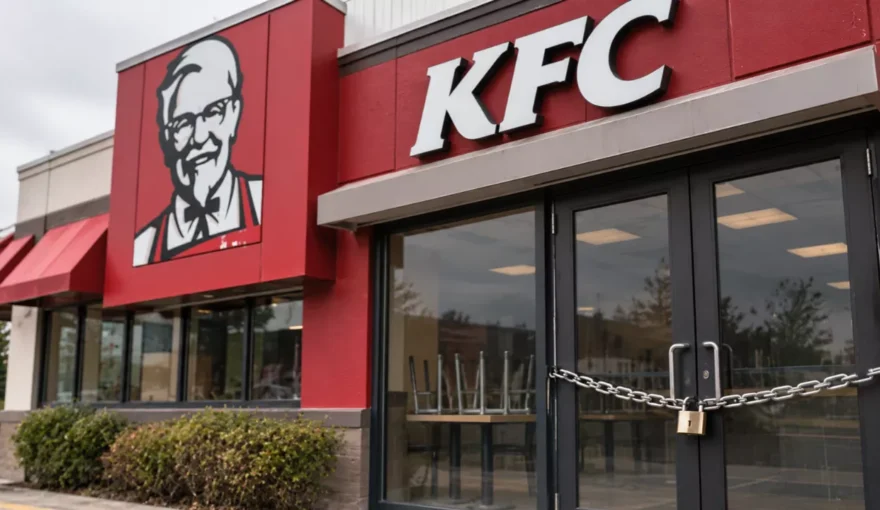
KFC store closures: See the full list of doomed restaurant locations as a large franchisee files for bankruptcy.
One of KFC’s larger U.S. franchise operators has filed for bankruptcy, and dozens of restaurants in the South and Midwest are already dark.
Tasty Chick’n LLC is a Texas-based franchisee. On Tuesday, it and several affiliates filed for Chapter 11 protection. At the time of the filing, the company ran 75 KFC restaurants and nine KFC/Taco Bell combo stores across 10 states. The court papers name more than 70 restaurants the company no longer thinks are worth keeping. Many of them seem to have closed before the petition was filed. Tasty Chick’n is now asking the court to let it walk away from those leases and give up the properties.

The money problem is easy to spot. Tasty Chick’n owes Yum Brands, KFC’s parent company, about $15.6 million in unpaid royalties.
Who Is Behind Tasty Chick’n?
Tasty Chick’n is managed by Tasty Restaurant Group (TRG), a multi-brand operator. TRG also runs Burger King, Pizza Hut, Dunkin’, and Taco Bell restaurants alongside its KFC stores. TRG itself is not one of the debtors in the case. The bankruptcy covers only Tasty Chick’n and its affiliated entities.
The company says it wants to sell its assets through the bankruptcy process. It is also looking at what it calls other “stand-alone restructuring alternatives.” It has not said whether more stores will close or how many workers will lose their jobs.
What Went Wrong
The filing describes a business that was being squeezed from several sides at once:
- Rising costs, falling sales. Operating expenses went up while revenue went down. Profit at the restaurant level has been dropping since 2023.
- Expensive remodel demands. Yum Brands pushed for costly upgrades to the stores, and the franchisee says it couldn’t easily pay for them.
- A termination warning. In September, Yum Brands sent Tasty Chick’n a “notice of intent” to end its franchise agreements.
Once the franchisor is threatening to pull the agreements and the royalty debt is in the eight figures, a bankruptcy filing becomes a way to buy time and control what happens next.
Full List of KFC Locations Closed or Closing
Here are the restaurants listed in the filing, by state. Tennessee is hit hardest, and Memphis alone accounts for 14 locations.

Alabama (5)
Boaz, Russellville (15045 US-43, which appears twice in the filing), Arab, Hartselle
Arkansas (10)
Walnut Ridge, Trumann, Mena, West Memphis, Hope, Nashville, De Queen, Forrest City, West Helena, Osceola
Florida (8)
Ormond Beach, Jacksonville (4 locations), Yulee, Neptune Beach, Quincy
Illinois (4)
Salem, Anna, Murphysboro, Robinson
Indiana (1)
Terre Haute

Kentucky (8)
Glasgow, Madisonville, Mayfield, Murray, Paducah (2 locations), Cave City, Owensboro
Missouri (3)
Perryville, Malden, Kennett
Mississippi (3)
Cleveland, Houston, Fulton
Tennessee (24)
Memphis (14 locations), Knoxville (4), Nashville (2), Franklin, Millington
Virginia (7)
Fredericksburg, Roanoke (2 locations), Salem, Emporia, Lexington, Franklin
If your local KFC is on this list and still open, it may not be for long. The company has asked to reject the leases for every location named.
A Bad Year for Restaurant Franchisees
Tasty Chick’n has plenty of company. In September, a franchisee running more than 300 Wendy’s restaurants filed for bankruptcy after weak sales and a strained relationship with its parent brand. Operators of Denny’s, Subway, and Moe’s Southwest Grill stores have taken similar steps. Together, these franchisees have closed hundreds of restaurants in 2026.
The pattern repeats. Labor, food, and rent costs keep going up. Customers are spending more carefully. Parent companies still expect franchisees to fund remodels and keep paying royalties on time. Smaller operators with thin margins feel this first.
KFC’s Bigger Problem at Home
The bankruptcy also points to a wider struggle for KFC in the U.S. In its latest third quarter, Yum Brands reported a 6% drop in U.S. KFC sales. Internationally, things look very different: KFC sales grew by double digits in places like the Middle East and Asia.
At home, the brand is fighting for attention in a crowded chicken market. Younger diners in particular have moved toward newer chains like Dave’s Hot Chicken and Raising Cane’s, which have built loyal followings on short menus and a strong brand identity.
Wall Street hasn’t panicked. Yum Brands (NYSE: YUM) stock was up roughly 6.3% for the year at last check, a little behind the S&P 500’s gain of about 7.25%.
Neither Yum Brands nor Tasty Chick’n has commented publicly on the filing so far. This is a developing story.