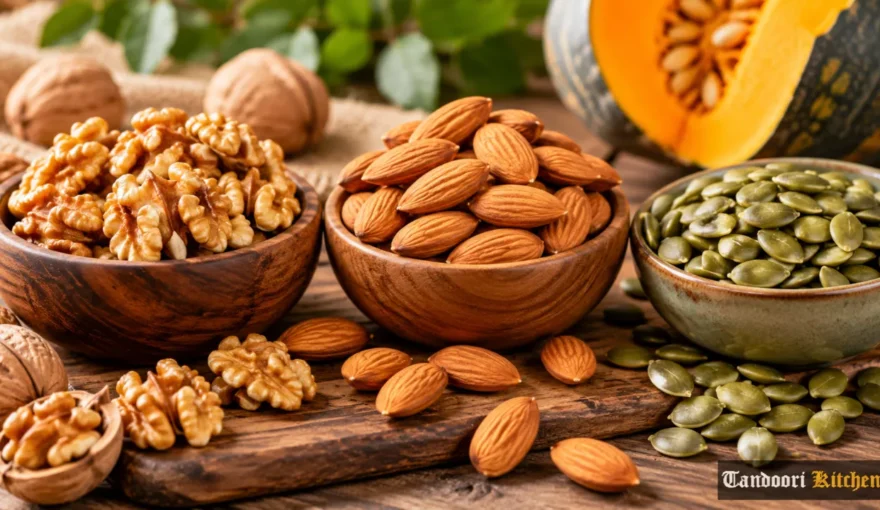
Walnuts vs Almonds vs Pumpkin Seeds: Which Is Healthier?
If you have ever stood in front of a jar of mixed nuts and seeds wondering what to scoop, you are not alone. The honest answer to “walnuts vs almonds vs pumpkin seeds, which is healthier?” is that none of them wins every category. Each one leads in something different, and the best choice depends on what your body needs most.
In brief: walnuts are your best plant source of omega-3 fat, almonds lead on vitamin E, calcium and protein among the nuts, and pumpkin seeds are the standout for zinc and magnesium at a lower calorie load per serving. The rest of this guide explains why, so you can pick with confidence.
Nutrition Comparison: Walnuts vs Almonds vs Pumpkin Seeds
The table below shows approximate values per 100 g, based on USDA FoodData Central figures. Pumpkin seeds are shown as whole, roasted and unsalted. Hulled (shelled) seeds are denser, with roughly 559 kcal, 30 g of protein and even more magnesium per 100 g. Check your own packet, because the form you buy changes the numbers.

| Nutrient (per 100 g) | Walnuts | Almonds | Pumpkin Seeds (whole, roasted) |
|---|---|---|---|
| Calories | ~654 kcal | ~579 kcal | ~446 kcal |
| Protein | ~15 g | ~21 g | ~19 g |
| Total fat | ~65 g | ~50 g | ~19 g |
| Fibre | ~7 g | ~12 g | ~18 g (shell included) |
| Omega-3 (ALA) | ~9 g | Negligible | Small amounts |
| Magnesium | ~158 mg | ~270 mg | ~262 mg |
| Zinc | ~3.1 mg | ~3.1 mg | ~10 mg |
| Standout nutrient | Omega-3, manganese, B6 | Vitamin E, calcium | Zinc, magnesium, iron |
A practical note: nobody eats 100 g in one sitting. A typical handful is about 28–30 g, so scale these numbers down to roughly a third.
Walnuts: The Brain-Food Favourite
Walnuts stand apart because they are the only one of the three with a substantial amount of alpha-linolenic acid (ALA), a plant-based omega-3 fat. Your body converts only a small portion of ALA into the longer-chain omega-3s found in fish, but ALA still contributes to heart-healthy eating patterns. Walnuts also provide meaningful manganese, copper and vitamin B6, and they contain polyphenols, which are plant compounds studied for their antioxidant activity.

The trade-off is energy density. Walnuts are the most calorie-dense of the three and the lowest in protein. That is not a flaw, since the fat is largely unsaturated, but it means portions matter. A small handful goes a long way.
Almonds: The All-Rounder
Almonds are the most balanced of the group. They offer the most vitamin E, a fat-soluble antioxidant, plus good amounts of calcium and magnesium and more protein than walnuts. Their fibre content is solid too, which helps explain why they feel filling. Many people find a few almonds hold off hunger better than a similar number of calories from a refined snack.

Almonds are a sensible default if you want one nut that covers many bases without extremes. They are lower in omega-3 than walnuts, and their zinc is modest compared with pumpkin seeds.

Pumpkin Seeds: Small, Mineral-Rich and Underrated
Pumpkin seeds (pepitas) are easy to overlook, but they are one of the richest everyday food sources of zinc, a mineral involved in immune function, wound healing and taste perception. They are also a strong source of magnesium, which supports muscle and nerve function, and of iron and phosphorus. Compared with walnuts and almonds, they carry fewer calories and less fat per 100 g, though that difference shrinks if you compare hulled seeds.
If you eat mostly plant-based foods, pumpkin seeds are particularly useful, because zinc and iron from plants can be harder to absorb. Soaking, sprouting or pairing seeds with vitamin C-rich foods can help. Their omega-3 content is much lower than that of walnuts, so they complement rather than replace them.
Which Is Healthiest for Your Goals?
Rather than crowning a single winner, match the food to your priority:
- Heart-healthy fats and omega-3: Walnuts
- Vitamin E, calcium and a filling snack: Almonds
- Zinc, magnesium and iron on fewer calories: Pumpkin seeds
- Weight management: Pumpkin seeds or almonds, with portions measured
- Plant-based diets: A mix of all three, so you cover omega-3, zinc and calcium together
The most realistic answer for most people is variety. A mix of walnuts, almonds and pumpkin seeds across the week is more useful than agonising over one “best” pick. Choose raw or dry-roasted, unsalted versions where you can, since salted, sugar-coated or oil-roasted mixes can undo some of the benefit. People with nut or seed allergies should avoid these foods, and anyone on a restricted diet or with a medical condition should check with a doctor or registered dietitian.
Frequently Asked Questions
Which is healthier overall: walnuts, almonds or pumpkin seeds?
No single one is healthiest overall. Walnuts lead on omega-3 fat, almonds on vitamin E and calcium, and pumpkin seeds on zinc and magnesium. Eating a mix is the simplest way to benefit from all three.
Which one is best for weight loss?
Pumpkin seeds and almonds are good choices because they provide protein and fibre, which help you feel full. All three are calorie-dense, so a portion of about a small handful (roughly 28–30 g) is the practical limit.
Do pumpkin seeds have more protein than walnuts?
Yes. Whole roasted pumpkin seeds contain roughly 19 g of protein per 100 g, compared with about 15 g in walnuts. Hulled raw pumpkin seeds are higher still, at around 30 g per 100 g. Almonds sit in between at about 21 g.
How much should I eat per day?
A common guideline is about 28–30 g (a small handful) of nuts or seeds a day. Your ideal amount depends on your calorie needs and health goals, so adjust with guidance from a healthcare professional if needed.